Why Every Wellness Pharmacy Needs a CRM
The pharmacies that will thrive in the next decade are not the ones filling the most prescriptions. They are the ones building the deepest patient relationships — and managing those relationships systematically.
A pharmacy CRM (Customer Relationship Management) system is the operational backbone that makes this possible. It tracks every patient interaction, automates follow-ups, segments populations for targeted outreach, and gives your team visibility into the entire patient journey — from first visit to long-term wellness engagement.
Pharmacies that treat patient relationships as a system — not a series of random encounters — will outperform those relying on memory, sticky notes, and good intentions.
Most independent pharmacies already have the trust. What they lack is the infrastructure to scale that trust into a structured care model. A CRM closes that gap.
What a Pharmacy CRM Actually Does
A pharmacy customer relationship management system is not a dispensing platform. It is not your pharmacy management system. It is the layer that sits between clinical operations and patient engagement — connecting the two in a way that drives retention, outcomes, and revenue.
Core functions include:
- Patient profiles with visit history, program enrollment, communication preferences, and health goals
- Automated outreach — appointment reminders, refill nudges, wellness check-in sequences, and birthday or milestone messages
- Segmentation — grouping patients by condition, program, engagement level, risk score, or referral source
- Task management — assigning follow-ups, flagging at-risk patients, tracking staff accountability
- Pipeline tracking — monitoring patients through enrollment funnels for wellness programs, screenings, or consultations
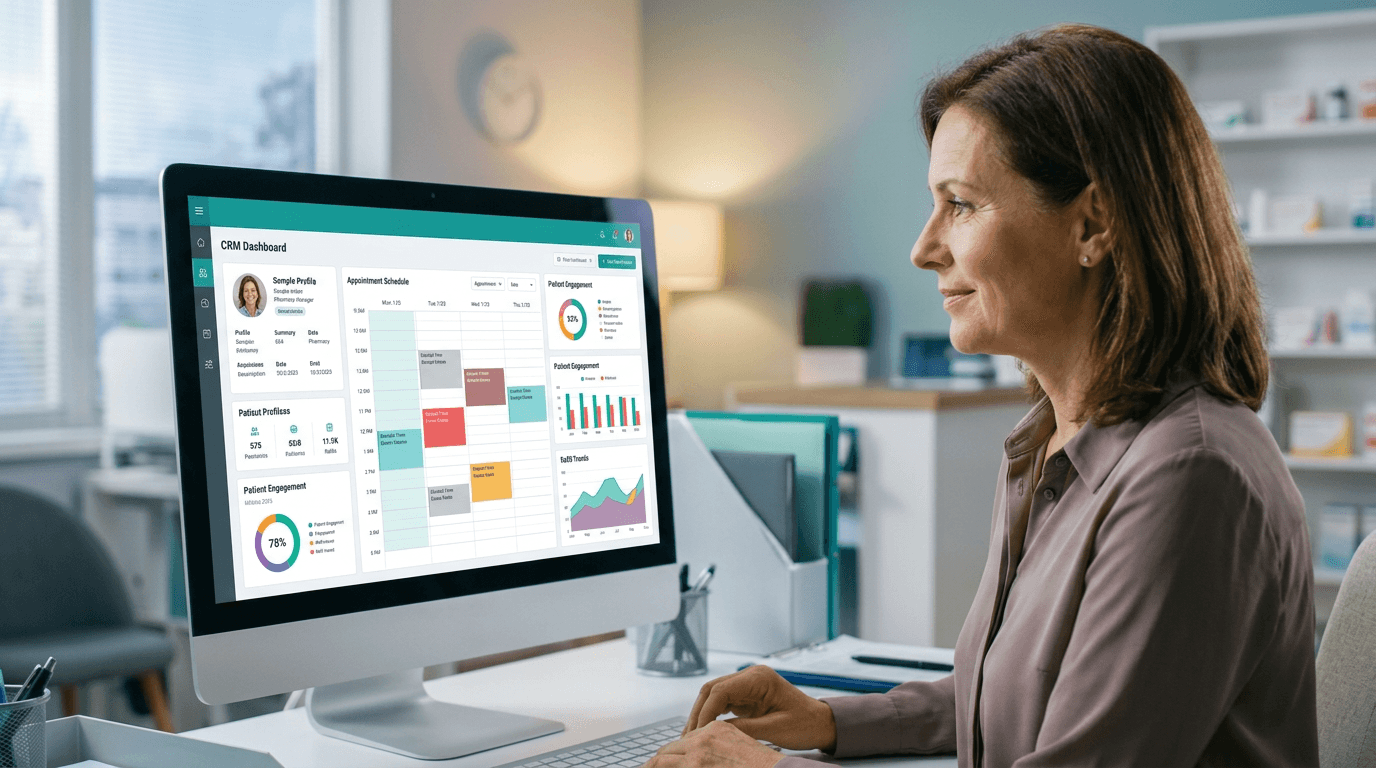
- Reporting dashboards — visualizing engagement rates, retention trends, and program performance
This is the difference between running a pharmacy and running a patient management operation. The CRM makes every relationship visible and every follow-up intentional.
The Cost of Not Having a System
Without a CRM, engagement depends entirely on individual memory and manual effort. The consequences compound:
Patients fall through the cracks. A patient who completed a metabolic screening three months ago never gets a follow-up. A new enrollee in your wellness program misses their second appointment and nobody notices. A high-risk patient stops coming in and no alert is triggered.
Marketing is reactive. You post on social media when you remember. You send a flyer when you have time. There is no systematic outreach strategy, no segmentation, and no way to measure what works.
Staff time is wasted. Your team spends hours making phone calls that could be automated. They manually track who needs follow-ups in spreadsheets or notebooks. High-value clinical time gets consumed by administrative coordination.
You cannot prove value. When a payer, grant funder, or employer asks for engagement data — enrollment rates, retention, follow-through, outcomes — you have nothing structured to show.
A pharmacy engagement platform eliminates these gaps by making the entire patient lifecycle trackable and actionable.
How to Choose the Right Pharmacy CRM
Not every CRM is built for healthcare, and not every healthcare CRM fits pharmacy. When evaluating pharmacy patient management software, prioritize these criteria:
Healthcare Compliance
The platform must support HIPAA-compliant data storage and communication. Patient health information cannot live in a generic marketing tool without proper safeguards. Look for BAA (Business Associate Agreement) availability, encrypted messaging, and audit trails.
Integration Capability
Your CRM should connect with your pharmacy management system, point-of-sale, scheduling tools, and any outcomes tracking platforms. Data silos destroy efficiency. The more your systems talk to each other, the more powerful your CRM becomes.
Automation Depth
Basic reminders are not enough. Evaluate whether the platform supports multi-step automation sequences — for example, a new wellness program enrollee receives a welcome message on day one, an educational resource on day three, a check-in prompt at week two, and a re-engagement sequence if they go inactive.
Ease of Use
Your staff will use this daily. If it takes 15 clicks to log a patient interaction, adoption will fail. Prioritize platforms with clean interfaces, mobile access, and minimal training requirements.
Scalability
Start with what you need, but choose a platform that grows. As you add programs, locations, or team members, the CRM should scale without a complete rebuild.
The RXI Wellness Pharmacy Model
The Wellness Pharmacy Network enables pharmacies to implement evidence-based programs that address nutrient deficiencies, reduce medication dependency, and improve long-term metabolic outcomes.
Building Patient Journeys Inside Your CRM
The most powerful feature of any independent pharmacy CRM is journey mapping — defining the exact sequence of touchpoints a patient experiences from their first interaction through long-term engagement.
Awareness Stage: A community member sees your social media content, attends a health fair, or gets a referral. The CRM captures their information and begins a nurture sequence.
Enrollment Stage: The patient books a consultation, enrolls in a wellness program, or completes an initial screening. The CRM triggers onboarding workflows — welcome communications, educational content, appointment scheduling.
Active Engagement Stage: The patient is attending appointments, completing check-ins, and progressing through a care plan. The CRM tracks adherence, flags missed touchpoints, and prompts staff when intervention is needed.
Retention Stage: The patient has completed an initial program cycle. The CRM initiates re-engagement — follow-up assessments, advanced program offers, referral requests, and satisfaction surveys.
Advocacy Stage: Engaged patients become ambassadors. The CRM helps you identify your most engaged patients and invites them to share testimonials, attend community events, or participate in referral programs.
Every stage is measurable. Every transition is intentional. This is what pharmacy marketing automation looks like when it is built for care, not just commerce.
Automation Workflows That Drive Results
The real value of a CRM is in the workflows you build. These are not one-time tasks — they are systems that run continuously.
New patient welcome sequence — Automatically sends a greeting, introduces available services, and prompts scheduling within the first week.
Missed appointment follow-up — If a patient no-shows, the system sends a rescheduling prompt within 24 hours and escalates to a staff call if there is no response within 72 hours.
Program milestone celebrations — When a patient hits a key milestone — 30 days enrolled, first body composition improvement, six-month anniversary — the CRM triggers a personalized message.
Re-engagement campaigns — Patients who have not visited in 60, 90, or 120 days automatically enter a win-back sequence tailored to their last activity.
Seasonal health campaigns — Pre-built sequences for flu season, diabetes awareness month, heart health campaigns, and back-to-school wellness checks launch automatically at the right time each year.
These workflows convert a single pharmacist's effort into a scalable engagement engine that runs even when you are focused on direct patient care.
Measuring CRM Impact
If you cannot measure it, you cannot improve it. Track these key metrics to evaluate your CRM investment:
- Patient retention rate — What percentage of patients return within 90 days?
- Program enrollment conversion — Of patients who express interest, how many actually enroll?
- Engagement score — How many touchpoints does the average patient complete per quarter?
- Follow-up completion rate — What percentage of automated follow-ups result in patient action?
- Reactivation rate — Of lapsed patients entered into re-engagement sequences, how many return?
- Revenue per patient — Are engaged patients generating more value through additional services?
These metrics tell the story of whether your CRM is working — and where to optimize.
Dr. Kathy Campbell, PharmD
Founder, Wellness Pharmacy Network
With decades of experience transforming community pharmacies into wellness destinations, Dr. Campbell has pioneered the integration of Food-as-Medicine programs, metabolic health tracking, and preventive care models into independent pharmacy practice. She leads the RX Institute in its mission to equip pharmacists with the tools and training to become the front line of community health.
Getting Started: Your First 30 Days
You do not need a perfect system to start. You need a functional one.
Week 1: Audit your current patient communication. Where are the gaps? What follow-ups are being missed? What data are you not capturing?
Week 2: Evaluate two to three CRM platforms against the criteria above. Request demos. Ask about pharmacy-specific use cases and HIPAA compliance.
Week 3: Select a platform and begin importing your patient base. Start with your most active program — wellness consultations, metabolic screenings, or adherence management.
Week 4: Build your first two automation workflows — a new patient welcome sequence and a missed appointment follow-up. Train your team. Go live.
The pharmacy that manages relationships intentionally will always outperform the one that leaves engagement to chance. A CRM is not overhead — it is the infrastructure that turns trust into a system and patients into a community.
"The pharmacies that win will not be the ones that fill the most prescriptions. They will be the ones that build the most intentional, measurable, and lasting patient relationships — and a CRM is how you do that at scale."
Download the Pharmacy CRM Comparison Guide
Get actionable strategies and frameworks you can implement today.
Download Free Guide