
Metabolic Health: The Clinical Frontier for Pharmacies
Metabolic syndrome now affects more than one in three American adults. It is the single largest driver of cardiovascular disease, type 2 diabetes, and preventable mortality in the United States — and most people who have it don't know it.
Here is the strategic reality: the healthcare system identifies metabolic risk too late. By the time a patient receives a diagnosis of diabetes or cardiovascular disease, years of reversible metabolic dysfunction have already passed unaddressed. Primary care visits are too short, too infrequent, and too focused on acute complaints to catch what is hiding in plain sight.
Pharmacies see these patients every week. The pharmacist who can identify cardiometabolic risk early — and deliver a structured intervention — is not offering a side service. They are filling a critical gap in the care continuum.
Metabolic health screening in pharmacy is not a wellness add-on. It is a clinical imperative that positions the pharmacist as the first line of cardiometabolic risk identification in the community.
Understanding the Metabolic Health Opportunity
Metabolic syndrome is defined by a cluster of interconnected risk factors: elevated waist circumference, high triglycerides, low HDL cholesterol, elevated blood pressure, and impaired fasting glucose. The presence of three or more of these markers constitutes a diagnosis — but the clinical reality is that risk begins accumulating long before the threshold is crossed.
The pharmacy opportunity exists because:
- Frequency of contact — Patients visit their pharmacy 2–3x more often than their physician
- Accessibility — No appointment, no referral, no insurance barrier for point-of-care screening
- Trust — Pharmacists consistently rank among the most trusted healthcare professionals
- Medication context — Pharmacists already see the prescriptions that signal metabolic dysfunction: statins, metformin, antihypertensives, and GLP-1 agonists
The patients filling these prescriptions are your metabolic health population. They are already in your pharmacy. The question is whether you are identifying them, engaging them, and tracking their outcomes — or simply dispensing their medications.
Building a Pharmacy Metabolic Screening Protocol
A credible pharmacy metabolic screening program requires structure. Ad hoc blood pressure checks and weight measurements are not a program — they are isolated data points with no clinical pathway.
The Five-Point Metabolic Assessment
A comprehensive pharmacy-based metabolic health assessment should capture:
-
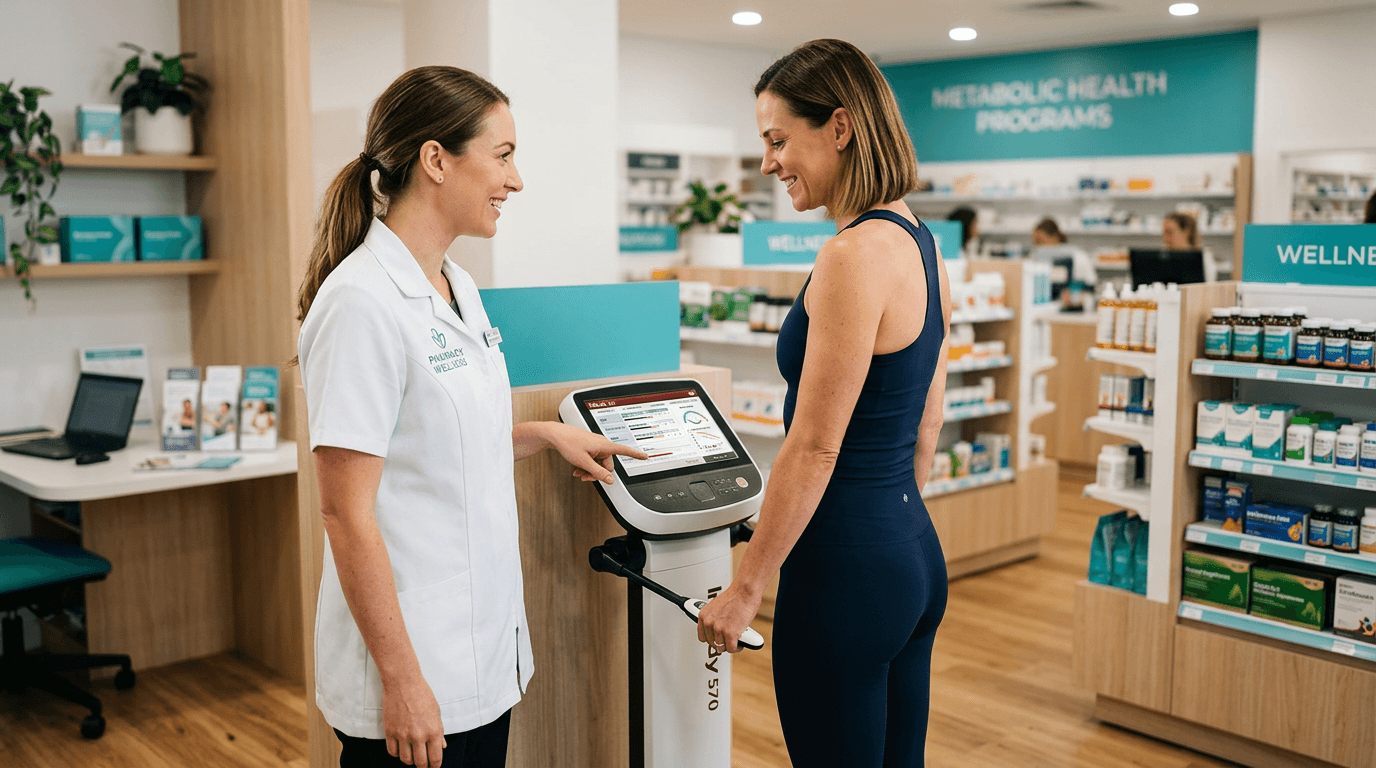
Body composition analysis — Not just BMI, but visceral fat, skeletal muscle mass, and body fat percentage using bioelectrical impedance analysis (BIA). This is the engagement anchor that brings patients back.
-
Blood pressure screening — Standardized, seated, dual-arm protocol with documentation and trend tracking over time.
-
Waist circumference measurement — A simple, high-value metric that correlates strongly with visceral adiposity and cardiometabolic risk.
-
Point-of-care blood glucose or A1C — Where state scope permits, fasting glucose or hemoglobin A1C testing provides the glycemic piece of the metabolic picture.
-
Medication and supplement review — Evaluating current prescriptions for drug-induced metabolic effects, nutrient depletions, and optimization opportunities.
Screening Workflow Design
The screening itself should take 15–20 minutes and follow a repeatable workflow:
- Patient identification — Flag patients filling metabolic-related prescriptions, those with elevated BMI, or those requesting weight management support
- Baseline assessment — Conduct the five-point assessment and document results
- Risk stratification — Categorize patients as low, moderate, or high cardiometabolic risk
- Intervention pathway — Route patients to the appropriate program tier based on risk level
- Follow-up cadence — Schedule reassessment at 30, 60, and 90-day intervals
This is how you turn a single screening into a longitudinal care relationship.
Clinical Protocols That Drive Outcomes
Screening without intervention is data collection, not care. The pharmacy metabolic health program must include actionable clinical pathways.
Tier 1: Education and Monitoring (Low Risk)
Patients with one or two metabolic markers receive education on lifestyle modification, nutritional guidance, and quarterly body composition reassessments. This tier builds awareness and engagement while establishing your pharmacy as a health destination.
Tier 2: Structured Intervention (Moderate Risk)
Patients meeting metabolic syndrome criteria enter a 12-week structured program that includes:
- Biweekly pharmacist consultations
- Nutritional intervention planning (Food-as-Medicine integration)
- Body composition tracking at 4-week intervals
- Medication therapy management focused on metabolic optimization
- Goal-setting around measurable biomarkers
Tier 3: Intensive Reversal (High Risk)
Patients with advanced metabolic dysfunction — uncontrolled diabetes, severe obesity, multiple comorbidities — receive intensive pharmacist-led coaching with weekly check-ins, coordinated care with prescribers, and aggressive nutritional and lifestyle intervention. This tier often includes collaborative practice agreement protocols where available.
The RXI Wellness Pharmacy Model
The Wellness Pharmacy Network enables pharmacies to implement evidence-based programs that address nutrient deficiencies, reduce medication dependency, and improve long-term metabolic outcomes.
Patient Engagement: Why Body Composition Changes Everything
The single most powerful engagement tool in a pharmacy metabolic health program is body composition analysis. Here's why: it gives patients something they have never seen before.
Most patients have only ever been told their weight and BMI. When you show a patient their visceral fat level, muscle mass, segmental lean analysis, and body water balance, you create an immediate, personal, visual understanding of their metabolic status.
This does three things:
- Creates urgency — Visceral fat data makes invisible risk visible
- Establishes a baseline — Patients now have a starting point they want to improve
- Drives return visits — Patients come back to see their numbers change
Body composition analysis transforms metabolic screening from a one-time event into an ongoing care relationship. It is the engagement engine that sustains the clinical program.
Revenue Models for Metabolic Health Programs
A well-structured pharmacy health assessment program creates multiple revenue streams:
- Direct screening fees — Cash-pay body composition scans ($25–$75 per assessment)
- Program enrollment — Monthly or quarterly membership for ongoing metabolic coaching ($49–$149/month)
- Supplement and nutraceutical sales — Evidence-based recommendations for nutrient depletions and metabolic support
- Medication therapy management billing — MTM services tied to metabolic optimization
- Employer wellness contracts — Corporate screening programs for local businesses
- Grant funding — Metabolic health programs align with rural health transformation priorities and HRSA funding criteria
The key is structuring these as programs, not transactions. A single body composition scan is a $50 sale. A metabolic health membership is a $1,200-per-year care relationship.
Outcome Tracking and Data Infrastructure
Funders, partners, and patients all want to see results. Your metabolic health program must be built on a foundation of measurable outcomes.
Track and report on:
- Enrollment and retention rates — How many patients enter the program, and how many complete it
- Biometric improvement — Changes in body composition, blood pressure, blood glucose, and waist circumference over 90-day cycles
- Medication optimization — Reductions in polypharmacy, dose adjustments, and deprescribing events
- Patient satisfaction — Net promoter scores, testimonials, and engagement metrics
- Cost impact — Estimated healthcare cost avoidance based on risk reduction
This data is what transforms your pharmacy from a dispensing location into a clinical outcomes center. It is what makes you grant-ready, partnership-worthy, and indispensable to the healthcare ecosystem.
Positioning Within the Healthcare System
Metabolic health programs give pharmacies a defined clinical identity. But the real power comes from integration — not isolation.
With prescribers: Share screening results and body composition data. Pharmacist-identified metabolic risk gives physicians actionable information they don't currently have. This builds referral relationships.
With payers: Document outcomes that demonstrate cost avoidance. Metabolic health programs that show measurable A1C reduction, weight loss, or blood pressure improvement create the evidence base for value-based care contracts.
With employers: Position your metabolic screening program as a workplace wellness solution. Employers are actively seeking community-based health services that reduce absenteeism and insurance costs.
With public health: Align your program with state and county health priorities around chronic disease prevention. This is the language that opens doors to grants and institutional partnerships.
Dr. Kathy Campbell, PharmD
Founder, Wellness Pharmacy Network
With decades of experience transforming community pharmacies into wellness destinations, Dr. Campbell has pioneered the integration of Food-as-Medicine programs, metabolic health tracking, and preventive care models into independent pharmacy practice. She leads the RX Institute in its mission to equip pharmacists with the tools and training to become the front line of community health.
The 30-Day Launch Framework
Week 1: Infrastructure — Select and install body composition analysis technology. Develop your screening protocol and documentation workflow. Train staff on the five-point metabolic assessment.
Week 2: Program Design — Define your three intervention tiers, pricing structure, and follow-up cadence. Create patient-facing materials that explain the program in clear, accessible language.
Week 3: Outreach — Identify your initial patient cohort from existing prescription data. Reach out to local prescribers and employers. Schedule your first screening events.
Week 4: Launch and Measure — Begin enrolling patients. Document every data point. Collect baseline body composition scans. Start building the outcomes dataset that will define your program's credibility.
The Strategic Imperative
The pharmacy that builds a metabolic health program today is not chasing a trend. It is responding to the largest chronic disease crisis in American history with a structured, evidence-based, community-accessible intervention model.
Cardiometabolic risk identification belongs in the pharmacy. The access is there. The trust is there. The clinical competence is there. What has been missing is the framework — the structured program, the measurement infrastructure, and the positioning strategy that turns clinical capability into a sustainable care model.
"Our pharmacy operates a pharmacist-led metabolic health program that identifies cardiometabolic risk early, delivers structured interventions, tracks measurable outcomes through body composition and biometric data, and integrates with prescribers and community health systems. We are a clinical outcomes center — not a dispensing counter."
That is the positioning that transforms a pharmacy.
Download the Metabolic Health Program Starter Kit
Get actionable strategies and frameworks you can implement today.
Download Free Guide